For eVTOL engineers, reducing weight isn’t simply an optimization exercise. Every component competes for a limited weight budget, making material decisions critical to overall aircraft performance. At the same time, AAM manufacturers are developing novel aircraft architectures while navigating rigorous safety and evolving certification requirements.
Yet when engineers design brackets, fittings, housings, airflow structures, and other components, metal is often the familiar starting point. The conventional question becomes: How can we make this metal component lighter?
But what if the better question is: Do all of these components need to be metal in the first place?
Rethinking material selection early in the design process can open a different path. Greene Tweed’s Xycomp® DLF™ discontinuous long fiber composites combine aerospace-grade carbon fiber with high-performance thermoplastics and matched-die compression molding, providing a high strength-to-weight ratio, excellent impact performance, thermal stability, chemical and environmental resistance, and galvanic corrosion mitigation.
Challenging the default use of metal doesn’t necessarily mean eliminating it. Engineers can rethink where metal is truly required and where composites can provide greater lightweighting and design advantages, creating opportunities to optimize the component around the needs of the application rather than the limitations of a conventional material choice.
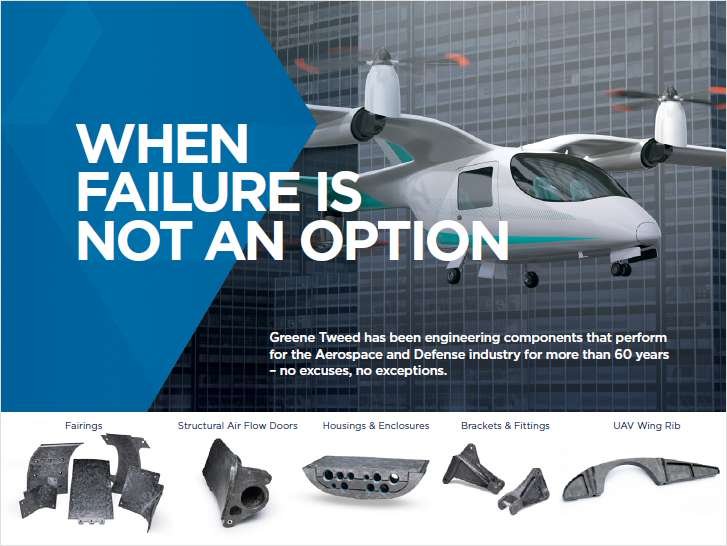
For weight-sensitive AAM applications, the impact can be significant. Xycomp® DLF delivers typical application weight savings of 35% to 50% compared to metal, with applications including brackets and fittings, airflow structures and fairings, housings and enclosures, lightweight structures, and UAV wing ribs. More than 400,000 Xycomp® DLF components are flying today. Explore how rethinking conventional metal components can uncover new opportunities to reduce weight, expand design possibilities, and meet the performance demands of next-generation eVTOL aircraft.